How Long Does It Take To Hike The Napali Coast?
The Kalalau Trail is 11 miles one way along the Napali Coast. Here is how long each section takes, what permits cost, and what to book instead if you cannot hike it.
How Long Does It Take To Hike The Napali Coast?
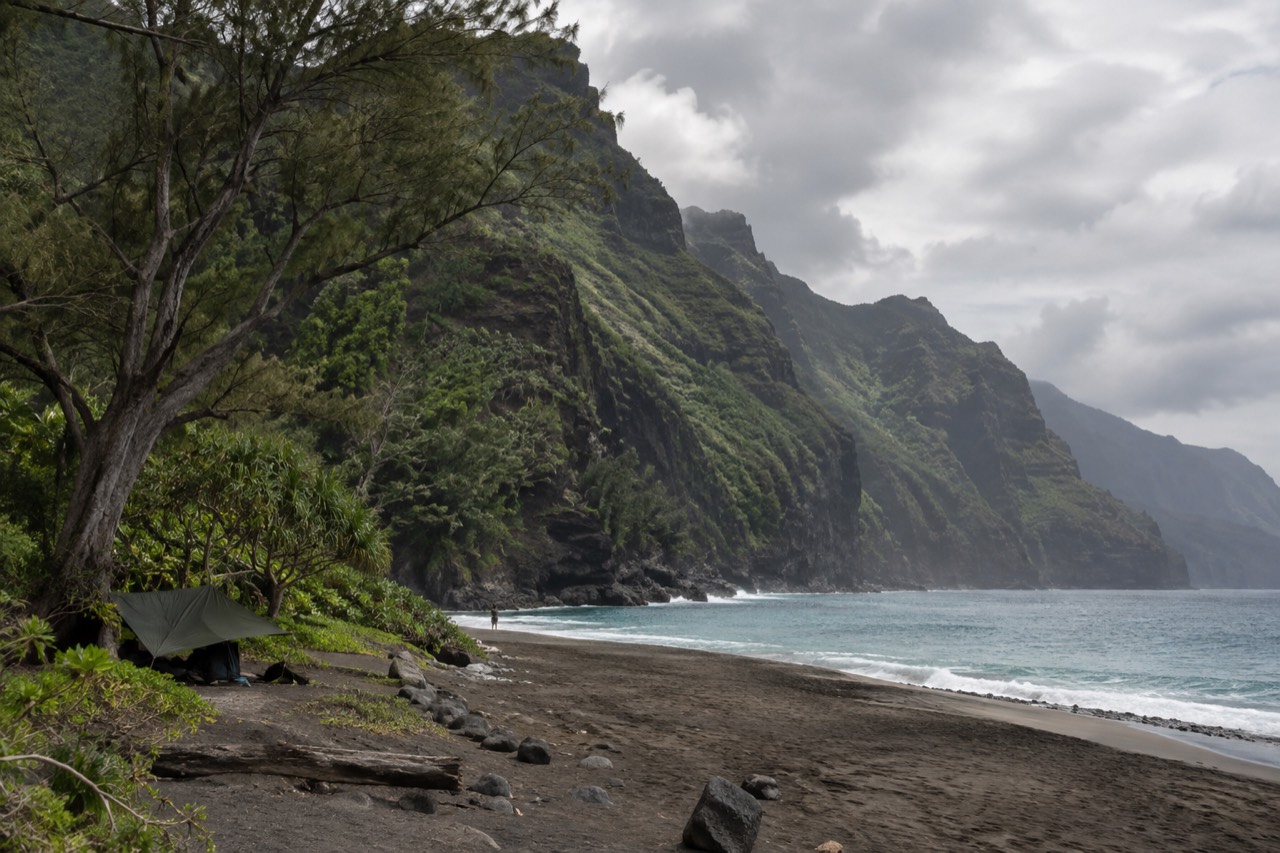
The Kalalau Trail is 11 miles one way from the trailhead at Haena to Kalalau Beach, crossing five major valleys inside Nāpali Coast State Wilderness Park. State Parks says most backpackers in good condition need a full day of hiking to cover it. Almost nobody day-hikes the whole thing. The realistic plan is two miles to Hanakapi'ai as a day hike, or an overnight permit and two very long walking days for Kalalau, and the permit is the part that actually decides your timeline.
That is the short version. The long version involves three stream crossings that swell without warning, red mud that turns to grease in rain, and a reservation system at Haena State Park that gates the trailhead itself. This page walks through each section of the trail with realistic timings, the permit costs and windows, and, because a large share of people researching this hike switch plans once they see the numbers, what a boat day looks like instead.
One thing to be plain about up front, because this site sells boat tours and honesty matters more than a conversion: none of the tours bookable here involve hiking. There is no hike product, no boat-plus-hike combo, no guided trek on this roster. If you want the trail, the trail is free to walk with permits. What this site can book is the water view of the same coast, and the last section of this page compares those options fairly.
How Long Does The Kalalau Trail Take?
For most hikers in good condition, the full 11-mile Kalalau Trail takes a full day of walking each way, so the standard trip is an overnight: two hard hiking days plus one or more nights camping in Kalalau Valley. Day visitors realistically cover only the first two miles to Hanakapi'ai Beach, roughly two to three hours round trip. The trail crosses five major valleys, and the state treats the full route as a backpacking trip, not a day hike.
The 11-mile figure and the five-valley count come straight from the state park's own trail page, which also carries the "full day" estimate for backpackers in good condition (Nāpali Coast State Wilderness Park info). That estimate deserves respect, because the trail is not 11 flat miles. It is 11 miles of alternating valley descents and cliff climbs, where every valley you drop into has to be climbed back out of on the far side. Hikers describe the middle sections, particularly the stretch above Hanakoa and the notorious Crawler's Ledge before Kalalau, as slow going even for experienced backpackers.
The wilderness park itself measures 6,175 acres along the rugged 16-mile northwest side of Kauai, and the trail is the only land access to most of it. That scale is the reason the timing question dominates every planning thread: you cannot sample the coast on foot in an afternoon the way you can from a boat. A boat covers the entire 16-mile coastline in hours; on foot, two miles is a half-day commitment and eleven is a life-list expedition.
For readers who have read this far and already feel the timeline slipping, the boat alternative is worth naming now, and this site's comparison set looks like this:
All three are real, bookable products with verified prices and ratings, and none of them requires boots, a permit or a backpack. The difference in time commitment is not subtle: a full Napali boat tour runs three to eight hours door to dock to door, while the trail asks for a minimum of one very long day and, for Kalalau itself, a permitted overnight. Both experiences see the same cliffs. Only one of them lets you sleep in.
What Do The First Two Miles Take?
The first two miles, trailhead to Hanakapi'ai Beach, take most day hikers 60 to 90 minutes each way, so figure two to three hours round trip plus time on the beach. This section needs no camping permit, only a Haena State Park entry reservation, at $5 per person plus $10 per vehicle for non-residents. It is the only part of the Napali Coast a casual visitor can legally hike in a single day.
The trailhead sits inside Haena State Park on Kauai's north shore, roughly 41 miles and an hour and a half drive from Lihue Airport. That distance matters more than most visitors expect, because the entry reservation system at Haena is the real gatekeeper: non-residents need both a park entry reservation at $5 per person and, if driving, a parking reservation at $10 per vehicle, released 30 days in advance (Haena State Park reservations). Hawaii residents enter free with ID. Parking is sold in time slots, and covering the park from opening to sunset means buying all three slots, which is why serious hikers set an alarm for the 30-day release.
The two-mile walk itself is the friendliest part of the trail and still not trivial. It contours along the cliffs above Ke'e Beach, drops to Hanakapi'ai Stream, and ends at a beach with no lifeguard and a well-earned reputation for dangerous currents. Do not swim there. The stream crossing at the half-mile mark can be ankle-deep in the morning and thigh-deep after an upvalley rain, and this is the pattern that defines the whole trail: the walking time is at the mercy of water.
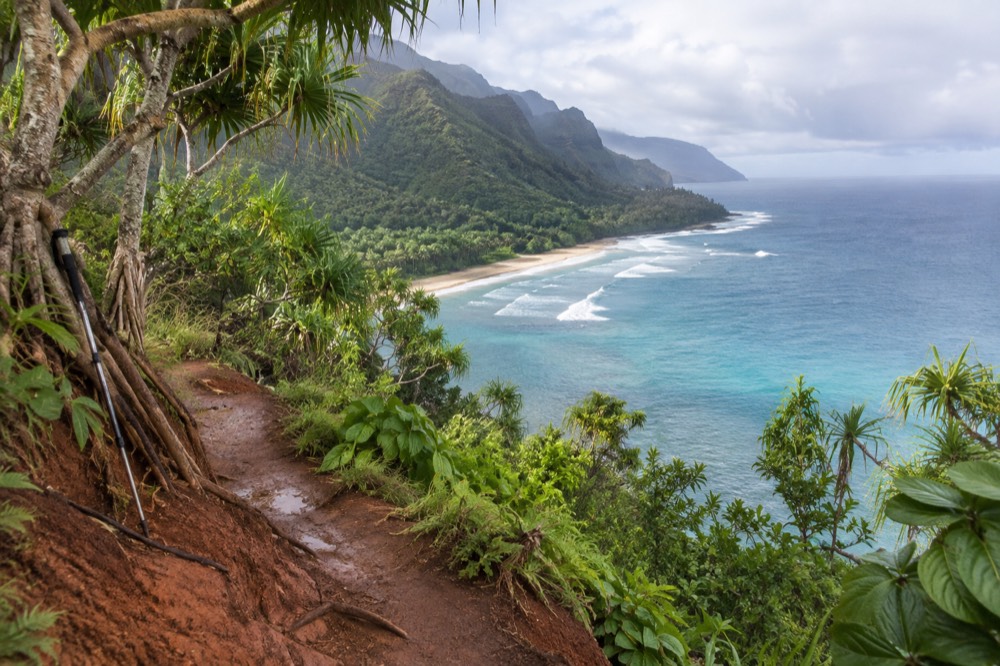
A realistic day plan, then, is not "two hours on the trail." It is: arrive at your parking slot, walk 60 to 90 minutes out, spend 30 to 60 minutes at the beach, walk back, and budget a total of four to five hours including the drive from wherever you are staying. If you are based in Poipu or Kapaa, the Haena round trip plus the hike eats an entire day of a short Kauai vacation, and the trailhead is neither free nor spontaneous: entry and parking are paid, and both sit behind advance reservations.
For anyone whose knees, schedule or permit luck rules out even this section, the boat is the honest alternative, and it is worth knowing what a booked boat day includes before you decide.
How Long Is The Full Eleven Miles?
The full trail is 11 miles one way to Kalalau Beach, and the standard itinerary is two days: hike in on day one, camp one to five nights, hike out on the final day. Each direction takes most backpackers a full day, eight to ten hours of moving time in decent conditions. The state caps camping at five consecutive nights, issued only for Kalalau Valley, also valid at Hanakoa.
Breaking the 11 miles into its real segments makes the timing concrete. The table below is the planning grid most hikers wish they had before booking permits.
| Segment | Distance one way | Typical time one way | Notes |
|---|---|---|---|
| Trailhead to Hanakapi'ai Beach | 2 miles | 60 to 90 minutes | Day hike, entry reservation only |
| Hanakapi'ai to Hanakoa Valley | 4 miles | 3 to 4 hours | Steepest sustained climbing, stream crossings |
| Hanakoa to Kalalau Beach | 5 miles | 4 to 5 hours | Includes Crawler's Ledge exposure |
| Full trailhead to Kalalau | 11 miles | 8 to 10 hours | Full day, overnight permit required |
Two structural facts shape every itinerary. First, camping permits are issued only for Kalalau Valley, with Hanakoa valid as a permitted stop, and the maximum stay is five consecutive nights. Second, permits open 90 days in advance and, per the state's own warning, often sell out months ahead, particularly in summer. So the honest answer to "how long does it take" includes calendar time: 90 days of planning lead, plus your hiking days, plus a buffer day in case weather closes the trail or a stream stalls you.
It is also worth stating what no commercial operator can do for you here, because misleading ads exist. It is illegal for anyone to provide commercial boat drop-off or pick-up at Kalalau or Milolii camping areas, and commercial guided camping trips along the coast are illegal too. The trail must be walked, from the trailhead, on foot. Any advertisement promising otherwise is, in the state's words, likely illegal.
What Permits Are Required?
Day hikers to Hanakapi'ai need only the Haena State Park reservation: $5 per person entry plus $10 per vehicle parking for non-residents, released 30 days ahead. Anyone continuing past Hanakapi'ai must hold a valid overnight camping permit for the Napali wilderness park: $25 per night for Hawaii residents, $35 for non-residents, bookable 90 days ahead, five-night maximum. No exceptions are made past Hanakapi'ai.
The two-permit structure confuses a lot of first-timers, so it pays to be precise. The Haena reservation gets you to the trailhead. The camping permit gets you past mile two. Since April 2021 the parking reservation no longer covers your passengers, so every person in the vehicle needs their own entry reservation as well. Hawaii residents are exempt from both Haena fees and pay the lower camping rate.
| Permit or reservation | Who needs it | Cost | Booking window |
|---|---|---|---|
| Haena park entry | All non-resident visitors | $5 per person | 30 days ahead |
| Haena parking | Non-resident drivers | $10 per vehicle | 30 days ahead, time slots |
| Napali camping permit, resident | Anyone past Hanakapi'ai | $25 per night | 90 days ahead |
| Napali camping permit, non-resident | Anyone past Hanakapi'ai | $35 per night | 90 days ahead |
Both systems are online, and both sell out. The camping permit window of 90 days with summer sellouts means a June Kalalau trip realistically had to be planned by late March. If you are reading this inside your trip with no permit in hand, the trail past Hanakapi'ai is closed to you, full stop, and no amount of fitness changes that. This is the single most common fork in the road: the permit, not the mileage, is what sends most people to the boat option.
How Hard Is The Terrain?
The terrain is consistently hard: narrow cliff contours, eroded red mud, exposed ledges and multiple stream crossings, with relentless valley descents and climbs over the full route. The middle miles past Hanakapi'ai are steeper and more exposed than the popular first section, and Crawler's Ledge before Kalalau is a narrow traverse above a serious drop. It is a backpacking route, not a coastal walk.
The state's own description of the coast hints at why: deep narrow valleys ending at the sea, with waterfalls and streams continuing to incise the valleys while the sea carves the cliffs. Every one of those valley mouths is a descent and a climb. The mud is the other constant. Kauai's west side is dry, but the trailhead end of the coast catches the wet trade-wind weather, and the path's red clay becomes slick within minutes of rain. Trekking poles, real footwear and gloves for the rope-assisted sections are standard advice on every serious trip report. The wider set of guides lives on Napali Coast Boat Tours.
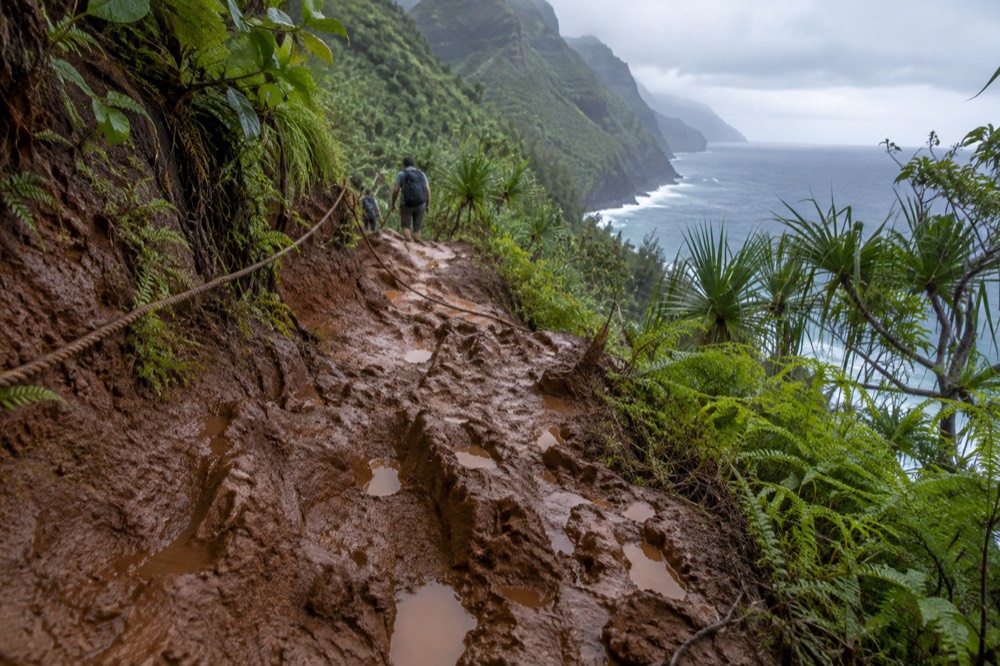
Fitness expectations should be calibrated to a full backpacking day, not a day hike. The state's "full day for most backpackers in good condition" assumes you are carrying your water, tent and food, and that conditions cooperate. Add rain, a swollen Hanakoa crossing or heat on the exposed ledges, and the same miles take hours longer. Injuries on this trail are a real category of Kauai incident, and rescue from the middle miles is not quick.
One more planning note for anyone packing a camera: unmanned aircraft, drones included, cannot be launched or landed in Hawaii state parks without written DLNR approval. The aerial footage that sells this coast online is not something you can legally recreate from the trailhead.
What Does Rain Do To It?
Rain changes everything: it turns the trail's clay to grease, raises the stream crossings from ankle-deep to dangerous, and can close the trail outright. The same coast is wet at the Haena end and dry at the Polihale end, and flash flooding in the valleys is a documented hazard. Winter months bring both the roughest conditions and the biggest north swells, so the wettest walking months and the roughest boating months overlap.
The mechanism is worth understanding because it drives both the hiking and the boating calendar. Kauai's rainfall is extraordinarily localized: the Haena end of the trail sits near one of the wettest spots on earth, while the coast's western end is near the island's dry leeward side. A morning that looks clear at your hotel in Poipu can be raining hard in Hanalei, and a stream that was a rock-hop at 8 a.m. can be impassable by noon. Every responsible itinerary builds in a weather buffer day, which again extends the honest answer to "how long does it take": one day of walking plus one day of slack.
The seasonal overlap is the detail most travel writing misses. The same November-to-April window that brings the largest seas to Kauai's north and west shores, the months when the Hanalei wave buoy records its biggest swell, is also the wettest, most flood-prone stretch for the trail. Summer is calmer and drier on both counts, which is exactly why summer permits sell out months ahead. If your dates fall in winter, the calculus shifts hard toward the boat, and the Napali Coast boat tour season page covers what actually runs month by month, because the widely repeated May-to-September dates are the kayak rules, not the boat rules.
What Do Hikers See That Boats Do Not?
Hikers see the inside of the coast: ancient Hawaiian terraces and walls, waterfalls you can stand under, the climb through Hanakoa's abandoned ruins, and Kalalau Beach itself, a mile of sand with no road and no crowd. Boats see the outside: the full 16-mile cliff face, the sea caves and the snorkel reefs, in hours instead of days. The two views are genuinely different, and the strongest Kauai itineraries use both.
The interior rewards are real and specific. Nu'alolo Kai, the archaeological complex on the coast, was continuously occupied for roughly 800 years, and Bishop Museum archaeologists excavated its stratified habitation deposits in 1958 through 1964. Boat passengers see Nu'alolo Kai from the water, and a small number of permitted raft tours land there, but hikers on the Kalalau Trail pass through the comparable ruins of Hanakoa, a valley with its own terraces, house sites and a waterfall, at a pace no boat tour can match. Kalalau Beach itself, the destination, is the thing no boat gives you: time on the sand, in the shade of the valley, with the day to waste.
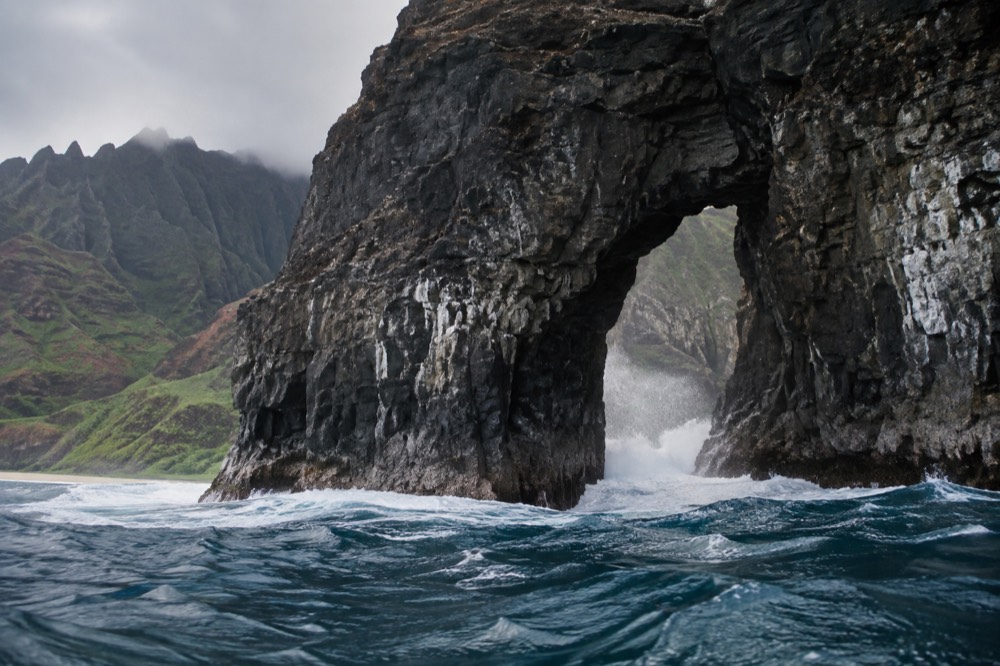
The boat's counter-argument is equally specific. The cliffs are the coast's defining feature, and their scale reads from the water in a way it never does from the path, because the trail spends most of its miles inside the valleys rather than looking at the coast's face. The sea caves, which rafts enter when conditions permit, exist below the trail entirely. Snorkel stops, spinner dolphins, the arch at Honopu seen end-on: all of it is a water-level experience. This is why the comparison is not either-or. The best Napali Coast boat tour question and the hike question answer different desires.
What Should You Book If You Cannot Hike?
If you cannot hike the Napali Coast, book a boat tour: this site's roster offers 26 verified products from $190 to $361.31 per person, all with free cancellation, running three to eight hours from Port Allen or Kikiaola. There is no hike product and no boat-plus-hike combo on this roster, and no tour here lands you at Kalalau. The closest legal shore experience is a raft tour permitted to land at Nu'alolo Kai, conditions permitting.
Being blunt about the gap is the point of this section. No tour on this site is a hike, no tour drops you at a campsite, and the only shore landings sold are the permitted Nu'alolo Kai stops on specific raft products, which are themselves conditions permitting and never guaranteed. What the roster does offer is the full coast, caves included, in half a day.
For the closest match to what the trail delivers, the small-raft products are the ones to look at. The Ultimate Na Pali Coast Zodiac Boat Snorkeling and Sea Cave Tour from Kauai Sea Rider Adventures runs 5 hours from Kikiaola, carries a maximum of 14 guests, includes a deli lunch, and is rated 4.7 from 111 reviews, from $257.28 per person. Small rigid-hull rafts are the vessels that can enter sea caves at all, since larger catamarans are too wide and too deep-drafted to fit, and this one pairs the cave run with a snorkel stop. Every product on the roster carries free cancellation, which matters when your whole plan depends on the ocean cooperating.
If a raft sounds too physical, the same coast is served by catamarans with meals included. The Na Pali Raft Snorkel Adventure from Kauai Sea Tours, a 5 hour 30 minute breakfast-included raft trip from Port Allen rated 4.8 from 1656 reviews, from $217 per person, splits the difference between the two formats, and the Napali Coast raft tours guide lays out the whole format fairly. The gentler option is the Amelia K, Makana Charters' 5-hour power catamaran from Port Allen with lunch included, rated 4.9 from 2050 reviews, from $227.13 per person, which carries more guests and skips the cave interiors. Whichever you choose, book early in your stay, not your last day, so a weather cancellation leaves room to rebook: operators reschedule or refund, but they cannot conjure a second calm morning.
The final comparison, in plain numbers, for readers choosing between the boot plan and the boat plan:
| Option | Time commitment | Cost | Permit or booking |
|---|---|---|---|
| Day hike to Hanakapi'ai | Half day plus drive | $5 entry, $10 parking | Haena reservation, 30 days ahead |
| Full Kalalau backpack | 2 hiking days plus nights | $35 per night camping | Permit, 90 days ahead, sells out |
| 5-hour raft tour | Half day from dock | From $257.28 | Book online, free cancellation |
| 5-hour catamaran tour | Half day from dock | From $227.13 | Book online, free cancellation |
Both plans put you face to face with the same 16 miles of cliffs. Only one of them asks for a permit, a backpack and a year's worth of planning luck, and only one of them can be booked for tomorrow. For the full selection, the three strongest options on this roster sit below.
Common Questions About Hiking The Napali Coast
How Long Does It Take To Hike The Napali Coast?
Eleven miles one way to Kalalau Beach, a full day of walking each way for most backpackers in good condition, so the standard trip is an overnight with a camping permit. Day hikers realistically cover only the first two miles to Hanakapi'ai, about two to three hours round trip.
Can you day hike the whole Kalalau Trail?
No. Past Hanakapi'ai Beach, at mile two, a valid overnight camping permit is required with no exceptions, and the full 11 miles take most backpackers a full day each way. The only legal day hike is the Hanakapi'ai section.
How far in advance do I need permits?
Haena State Park entry and parking reservations open 30 days ahead. Napali camping permits open 90 days ahead and often sell out months in advance, especially in summer, at $35 per night for non-residents.
Can a boat drop me at Kalalau so I only hike one way?
No. Commercial boat drop-off and pick-up at Kalalau or Milolii camping areas is illegal, and commercial guided camping trips along the coast are illegal too. The trail must be walked from the trailhead at Haena.
Is the first two miles hard?
It is moderate but not trivial: cliff contours, one stream crossing and a rocky beach at the end, typically 60 to 90 minutes each way. It is far gentler than the middle miles, which involve sustained climbing and exposed ledges.
What is the alternative if I cannot get a permit?
A Napali Coast boat tour. This site's roster runs three to eight hours from Port Allen or Kikiaola, from $190 to $361.31 per person, all with free cancellation, and covers the full coastline including the sea caves that the trail never touches.