What Is The Best Month To Go To Kauai?
A month-by-month breakdown of Kauai weather, ocean conditions, whale season, crowds and costs, written around the one factor that decides a Napali boat day: the swell.
What Is The Best Month To Go To Kauai?
Kauai does not have a bad month in the way most destinations do. Temperatures at Lihue stay in a narrow band all year, the January mean maximum is 78.6°F per the 1991 to 2020 NOAA normals for the island's airport station, and the west side where the Napali boat tours depart is drier still. What changes month to month is the ocean. Northwest swells arrive from roughly November through March, and they are the single factor that decides whether a boat reaches the Napali Coast, whether the sea caves are open, and whether a snorkel stop happens. Choose your month for the sea, not for the air.
What Is The Best Month To Visit Kauai?
For most visitors the best month is June, with July and August close behind, because the summer months combine the calmest offshore sea state on record with dry weather and the widest choice of boat tours. If whales matter more than water clarity, late January and February are the peak sighting months, but the same swell that brings the whales makes the rougher coast runs less reliable then.
The honest answer is that the best month depends on what you are booking the trip around. Two recent years of measured data from the NOAA and PacIOOS wave buoy off Hanalei show June through September essentially never recording significant wave heights at or above 2.5 metres: between 0.1% and 1.6% of observations in each of those months. December and January, by contrast, sit at or above that threshold about half the time. That is the difference between a near-certain Napali Coast run and a coin-flip.
Summer also carries the crowds. Hawaii DBEDT counted 139,974 visitor arrivals on Kauai in July 2026, the island's busiest recent month, against 647,009 for the whole first half of the year. If you want calm water you accept company. If you want empty trails and cheaper rooms, the shoulders in April, May, late September and October trade some weather risk for space, and the water is still often workable. The whale months, December through March, are the wettest and roughest but the most rewarding for wildlife.
For readers planning the trip around a boat day, the deeper comparison of the Napali Coast boat tour season covers the operator-by-operator windows, and it is worth reading before you pin a date.
What Do The Two Seasons Look Like?
Kauai runs on two seasons rather than four: a dry, calm summer from roughly April through October, and a wetter, swell-driven winter from November through March. Summer brings trade winds, small surf and reliable boat access to the Napali Coast. Winter brings northwest swells, more rain on the wet sides of the island, humpback whales, and tours that adjust routes or drop snorkel stops.
The summer season is the island's working season. Trade winds blow most reliably from June through August, and the leeward waters off the west side, where Port Allen and Kikiaola sit, stay in the wind shadow long enough for morning tours to run comfortably. The boat roster reflects this: nearly every product on this coast runs year round, conditions permitting, but the summer versions carry the full itinerary, caves, snorkel stops and beach landings included.
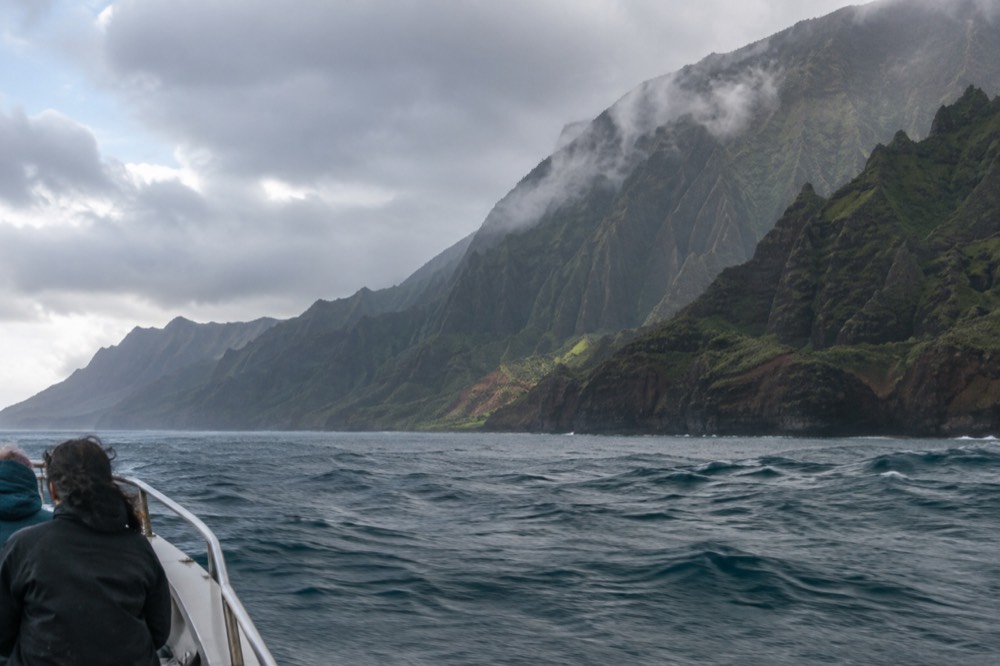
Winter is a different island. The same northwest swells that make the north shore famous for surfing push the Hanalei buoy's monthly mean wave height from a summer low around 1.4 metres to a January high of 2.77 metres. Operators respond honestly: some drop lunch from shoulder-season tours to avoid waste when cancellations are likely, some run sightseeing-only products, and the whale-watch trips that run in winter deliberately go to the west or south shores rather than the Napali Coast at all. Rain concentrates on the windward and mountain interiors; the west side around Waimea stays comparatively dry, with a January mean maximum of 79.5°F at the Waimea station.
| Season | Months | Typical pattern | What it means for a boat day |
|---|---|---|---|
| Dry and calm | April to October | Small surf, steady trades, west side sheltered | Caves, snorkel stops and landings most reliable |
| Shoulder | April, May, late September, October | Mixed conditions, smaller crowds | Good value, book early in your stay to allow a rebook |
| Wet and swell | November to March | Northwest swells, rain on windward sides | Whale watching at its peak, Napali runs less certain |
The practical rule that falls out of this: book the month for your priority, then book the boat early in the stay. Operators reschedule before they refund, and a trip with three spare days behind it survives a blown-out morning that a departure-eve booking does not.
Which Months Give Calm North Shore Water?
June through September give the calmest measured water off Kauai's north shore, with the Hanalei buoy recording mean significant wave heights of 1.40 to 1.61 metres and essentially no observations at or above 2.5 metres. May and October are genuine shoulder months. November through February is when the big northwest swell arrives, and January is the roughest month on the record.
The numbers behind that come from two full years of the buoy's standard meteorological record, reduced to monthly significant wave height. They are two recent years, not a 30-year climatology, and the buoy sits offshore in deep water, so the figures describe sea state rather than breaker height at the beach. Even with those caveats the pattern is unambiguous. July's mean is 1.50 metres and its 90th percentile is 1.99 metres; January's mean is 2.77 metres and its 90th percentile is 4.01. Those are different oceans.
For the north shore specifically, this matters more than anywhere. There is no small boat harbor at Hanalei; boats work off the open bay, so the north-shore products are the first to go seasonal and the first to drop to sightseeing-only formats when the swell builds. The National Weather Service in Honolulu issues high surf advisories for Kauai's north-facing shores at 15 feet and warnings at 25, thresholds that winter storms cross regularly.
One caution worth carrying into any month: the widely repeated claim that boat tours only run from mid-May to early September is wrong. Those dates are the kayak and Miloliʻi landing rules, and travel writing mis-applies them to motor boats. West-side motor-boat tours run all year, conditions permitting, which is the next section's subject.
Which Months Suit The West Side?
Every month suits the west side, because all 26 tours on this coast depart from Port Allen or Kikiaola on the sheltered south-west shore and run year round, conditions permitting. What changes is the product: summer carries cave entries, snorkel stops and beach landings at full reliability, while winter tours run shorter, sometimes sightseeing-only, with the caves and snorkelling less likely.
The west side is where the island's boat infrastructure actually lives. Port Allen Small Boat Harbor in ʻEleʻele has 34 berths, a loading dock and restrooms per the state's Division of Boating and Ocean Recreation, and 18 of the tours in our roster leave from it. Kikiaola, near Waimea and Kekaha, is smaller, with four moorings restricted to vessels of shallow draft, and it sends the other eight. Being on the leeward corner of the island means these harbors sit behind the worst of the winter swell for longer than any north-shore option.
That geography is why a January visitor can still board a Napali boat. What the winter booking buys is a shorter, more conditional version of the summer product. The Amelia K's five-hour tour from Port Allen, 4.9 from 2,050 reviews and from $227.13 per person, runs all year with lunch included, and the express sunset products keep running through the winter too. The snorkel-specific tours are the ones to check seasonally: one Kauai Sea Tours express snorkel product runs April to December, and the afternoon snorkel runs on several operators narrow to the calm months.
For a summer or shoulder booking, the Napali Navigators five-hour snorkel tour with lunch, 5.0 from 23 reviews and from $215 per person, departs Kikiaola and includes cave runs and a deli lunch. It is a small-review-pool product, so read the recent reviews on the live listing rather than trusting the round number, but the format, a west-side departure with the full summer itinerary, is exactly what the April to October window rewards.
When Are The Whales Here?
Humpback whales are in Hawaiian waters from November through April, with the strongest sightings around late January and February. On Kauai the community-science counts peak in those same months: the February 2026 Sanctuary Ocean Count recorded 337 whale sightings from Kauai's shore stations alone. The trade-off is structural, the whale months are the same months the buoy records the largest seas.
The overlap is not a coincidence, it is the trip's central tension. The whales and the swell arrive together, which is exactly why the winter whale products depart the west side and stay off the south and west shores rather than attempting the Napali Coast. A dedicated whale-watch trip in January is a reliable booking. A Napali Coast tour in January is a conditional one. Some visitors book both: a whale morning and a coast afternoon, accepting that the second may reschedule. The full index of guides sits on Napali Coast Boat Tours.
Federal rules shape the encounter regardless of month. Vessels may not approach within 100 yards of a humpback anywhere in Hawaiian waters, and aircraft must stay 1,000 feet away, under the approach regulations effective since January 2024. Spinner dolphins carry their own 50-yard vessel limit within two nautical miles of the main islands. A lawful tour watches from distance, and the good ones explain that before you board.
If whales are the reason for the trip, the month-by-month detail is in the best month to see whales in Kauai, and the honest framing of what a winter Napali run can and cannot promise is in when not to go to Kauai.
Which Months Are Wettest?
The wettest months on Kauai are November through March, when the winter swell regime coincides with more frequent rain on the windward and mountain sides of the island. The west side, where the boat harbors sit, is the driest part of the island in every month. The Lihue station's January normals show 2.78 inches of rain across 12 days, while Waimea's January mean maximum temperature is 79.5°F.
Kauai's rainfall is a geography story before it is a calendar story. The island's interior, around Mount Waiʻaleʻale, is one of the wettest places on earth, and the Rainfall Atlas of Hawaiʻi, based on the 1978 to 2007 period, maps the gradient from there to the leeward plains in sharp detail. A winter storm can dump rain on the east and north shores while the boat leaves Port Allen under blue sky. Operators say it plainly: tours do not cancel for rain alone unless safety is in question, and it is common for it to be raining on land while conditions stay clear out on the water.
What rain does affect is everything around the boat day. Trail conditions on the Kalalau side degrade in the wet months, stream crossings rise, and the state park's camping and day-use systems run at lower availability. The road to the north shore trailheads can flood in sustained winter rain. If your itinerary pairs a boat day with a Haʻena or Waimea Canyon day, the summer months protect both halves of the plan.
For pure weather optimisation, the practical read is: any month works for the west side, summer protects the whole island, and winter rain is a reason to build schedule slack, not to stay home.
Which Months Cost Most?
The most expensive months are mid-December through March for lodging and June through August for peak-season demand, while the cheapest windows with acceptable weather are late April, May, late September and October. Tour prices on this coast barely move by month, from $190 to $361.31 per person across all 26 products year round, so the date you choose moves your hotel bill far more than your boat ticket.
The boat tours themselves hold their prices across the calendar. The roster's floor, $190 per person on the express sunset product from Port Allen, and its ceiling, $361.31 on the eight-hour Niʻihau expedition, are the same figures in February and July. What changes by month is availability and the chance the tour you want actually delivers its full itinerary, which is a different kind of cost.
Lodging and transport are where the month bites. Hawaii's transient accommodations tax rose to 11% effective January 1, 2026 under Act 96, and Kauai County adds its own 3% on top, so the combined tax load on a room is 14% before the nightly rate. The rental vehicle surcharge is $7.50 per day. None of that varies by month, but the base rates under it swing hard around the holidays and the summer peak, and DBEDT's monthly arrival figures show exactly when demand concentrates: 139,974 arrivals in July 2026 against a first-half total of 647,009, a month-by-month spread that peaks in summer and around the holidays.
| Month group | Tour price behaviour | Lodging and demand | Best for |
|---|---|---|---|
| January, February | Same prices, more reschedules | Lower demand, whale peak | Whales on a budget, with slack days |
| March, April | Same prices, mixed sea state | Shoulder rates | Value trips, first snorkel reliability |
| May, early June | Full itineraries return | Rising demand | The best overall balance |
| July, August | Full itineraries, busiest boats | Peak rates | Guaranteed calm, accept crowds |
| September, October | Full itineraries, thinning crowds | Shoulder rates | The connoisseur's window |
| November, December | Shorter products, whale arrival | Holiday spike mid-December | Whales, low-season rates outside the holidays |
Which Month Should You Book?
Book June if you want the highest-probability full Napali experience, caves, snorkel and calm water, and accept crowds. Book late September or October for nearly the same ocean with shoulder rates and thinner trails. Book late January or February if whales are the point and you will trade cave entries and snorkel stops for them. Book nothing around mid-December if price matters.
The decision reduces to one question: is the boat day the trip, or is it one item on the list? If the Napali Coast run is the reason for the flights, protect it. June through September gives the measured calm, the full product range and the shortest odds of a reschedule. The shoulder months, especially late September and October, deliver most of that at lower cost, and the two-year buoy record shows October's mean wave height at 1.76 metres, workable and only a shade above May's 1.73.
If the boat is a maybe and the whales are a must, invert everything. Late January and February are the sighting peak, the whale-watch products run reliably off the sheltered shores, and a coast tour booked for the same week should be treated as a bonus that may convert to a reschedule. Build three spare days into either plan; every operator here offers free cancellation and reschedules before refunding, but a reschedule needs a calendar slot to land in.
For a summer or shoulder-date trip built around the water, the express snorkel product aboard ʻImiloa, 4.7 from 346 reviews, from $212 per person with two meals and a 36-guest cap, is a compact way to buy the calm-season itinerary without committing a whole day. It runs April through December, which matches the window this whole article points toward.
Whichever month wins, book the boat for early in the stay, not the last morning. The single most common planning failure on this coast is not picking the wrong month, it is pinning the only boat departure to the final day, leaving no room for the ocean to have an opinion.
Common Questions About The Best Month To Visit Kauai
What Is The Best Month To Go To Kauai?
June is the best single month for most visitors: measured ocean conditions are at their calmest, every boat itinerary runs in full, and the weather is dry. Late September and October are close behind with fewer crowds and lower rates. Choose late January or February instead if humpback whales are the priority.
What is the rainy season on Kauai?
The wetter months run roughly November through March, concentrated on the windward and mountain sides of the island. The west side, where the boat harbors sit, stays comparatively dry all year, and tours do not cancel for rain alone unless safety is in question.
Do Napali Coast boat tours run in winter?
Yes. West-side motor-boat tours from Port Allen and Kikiaola run year round, conditions permitting. Winter tours are shorter and more conditional, with cave entry and snorkel stops less likely, and some operators run sightseeing-only formats in the roughest months.
Which month has the biggest waves?
January. The Hanalei buoy's two-year record shows a January mean significant wave height of 2.77 metres, with just over half of observations at or above 2.5 metres. June through September, by contrast, almost never reaches that level.
When is whale season on Kauai?
Humpbacks are present in Hawaiian waters from November through April, with sightings peaking around late January and February. Kauai's shore stations recorded 337 whale sightings in the February 2026 community count. Whale-watch tours run off the west and south shores in those months.
Are tours cheaper in the off season?
The boat tours hold the same prices year round, from $190 to $361.31 per person across the coast's roster. What gets cheaper in the shoulder and whale months is lodging and car rental base rates, since Hawaii's 11% state tax and Kauai's 3% county tax apply in every month.