Will I Get Seasick On A Napali Coast Boat Tour?
An honest answer to the seasickness question for Napali Coast boat tours: which water is roughest, which boats and months are calmest, and what actually works to prevent it.
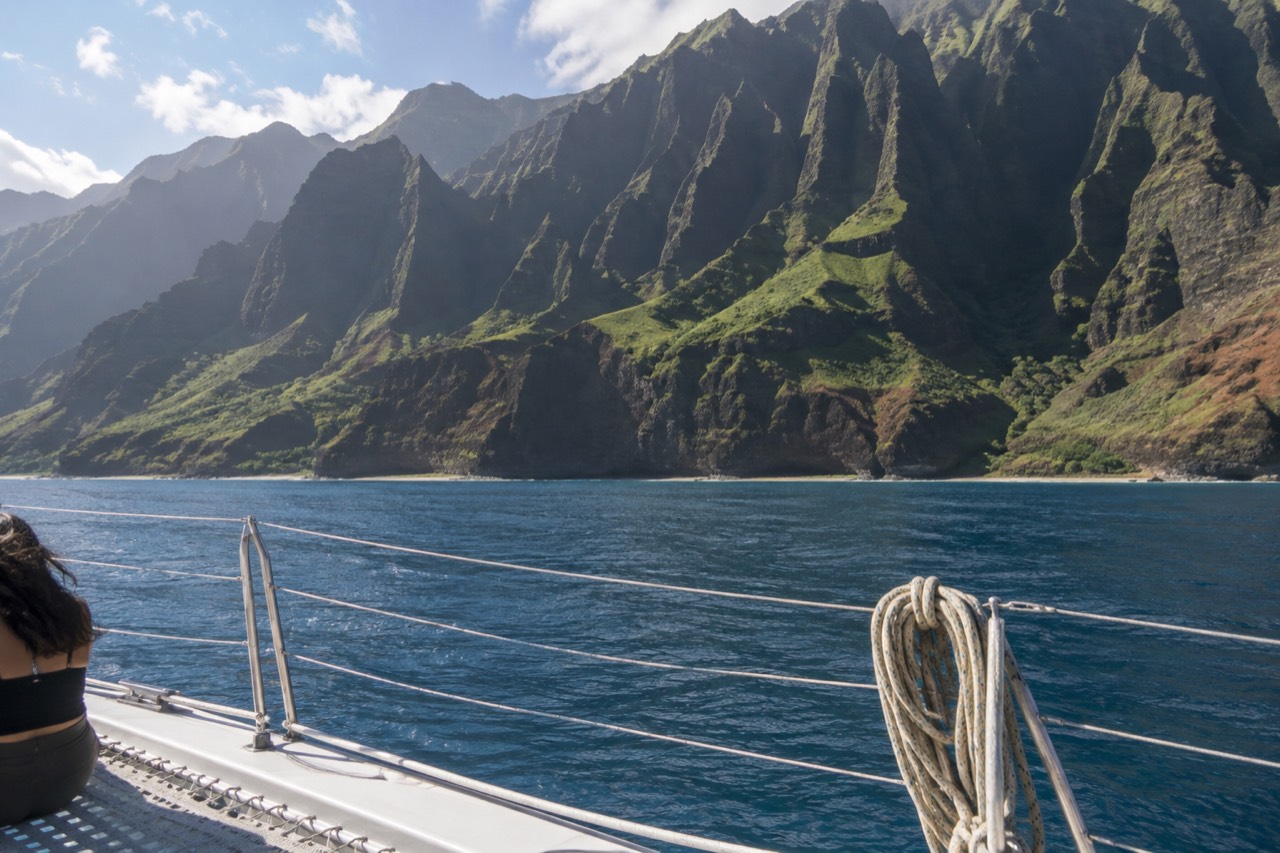
Will I Get Seasick On A Napali Coast Boat Tour?
Roughly one in three people are prone to motion sickness in some form, and the Napali Coast is open ocean, not a sheltered bay cruise. That is the honest starting point. But the coast is also on Kauai's leeward west side, the boats that run it range from bone-shaking rafts to wide, steady catamarans, and the summer sea state along this coast is about as gentle as Hawaiian waters get. The people who get sick are usually the ones who booked the wrong boat, the wrong month or the wrong seat, or who did nothing at all to prepare. This page walks through each of those decisions in turn, because nearly all of them are within your control.
Will You Get Seasick On A Napali Boat Tour?
Probably not, if you book well: most guests complete a Napali tour without incident, but the coast is open ocean and a minority do get sick, especially on raft tours in winter swell. Your real risk factors are boat type, month, tour length and whether you medicate beforehand. All four are choices you make before you ever step aboard.
The first thing to understand is what kind of water you are on. Napali Coast tours depart from Port Allen or Kikiaola on Kauai's west and south-west side, and the coast itself faces north-west into the open Pacific. This is not a river estuary or a harbor loop. Once a boat clears the headland it is in ocean swell, and the swell is what triggers motion sickness in most people. The medical mechanism is a mismatch between what your inner ear feels and what your eyes see, and a rolling deck is the classic trigger.
The second thing is that the odds are strongly shaped by your own choices. A five-hour rigid-hull raft ride in December is a very different motion experience from a four-and-a-half-hour power catamaran in July, even though both are sold as "Napali Coast tours". Operators themselves flag this: Holo Holo Charters states plainly that its tours are not suitable for people with back or neck problems or for pregnant women, which tells you the motion can be genuine even on the bigger boats.
Third, seasickness on this coast is usually preventable rather than inevitable. The remedies that work are well studied, cheap and available over the counter, and the seating and gaze habits that reduce it cost nothing. The sections below take each factor in turn: the water, the boat, the month, the prevention, the seat and the fallback.
If you already know you are prone to motion sickness, the three tours above are a sensible shortlist to start from, and the rest of this page explains exactly why.
Which Stretch Of Water Is Roughest?
The open-water legs are the roughest: the crossing from Port Allen or Kikiaola out to the coast, and especially the exposed north-west-facing stretch of cliffs, which takes the full Pacific swell. The calmest water is typically inside the valleys and bays where the cliffs block the wind. On a rough day the outbound leg is where sensitive stomachs struggle first.
The Napali Coast runs 16 miles along Kauai's north-west side, and the state describes it as a rugged wilderness shoreline where deep, narrow valleys end at the sea. A tour boat leaving Port Allen first crosses the relatively open water off the south-west shore, then turns north-west to run the cliff line. The cliff line itself faces the prevailing swell direction, which is why the sea state along it, rather than the flat water inside the harbors, is what decides whether caves can be entered and snorkel stops can run.
The direction of the swell matters more than most first-timers realize. Hawaii's wave climate sends long-period north Pacific swells at the islands from November through March, and those hit the Napali cliffs square on. In summer the dominant energy is smaller trade-wind chop and occasional south swell, and the north-west exposure goes quiet. The National Weather Service in Honolulu sets its high surf criteria by shore orientation for exactly this reason: 15 feet triggers an advisory for Kauai's north-facing shores and 12 feet for west-facing ones, while south-facing shores get an advisory at 10 feet. When those advisories fly, tour boats adjust routes or cancel outright.
There is a practical takeaway here. The roughest minutes of most tours are the open-water crossing, before the cliffs give the boat any shelter, and the stretch around the exposed points between valleys. If your stomach survives the crossing, you are usually past the worst, because inside the valleys the water is often noticeably calmer. Captains also read the day rather than the clock: one raft operator states that cave entry is governed by ground swell size, not time of day, which means a rough morning can calm by afternoon and vice versa.
The other rough-water trip worth naming is the Niihau run. Those tours cross the Kaulakahi Channel, which measures 17.2 statute miles between Kauai and Niihau with depths reaching 3,570 feet along the measured line. A channel crossing of that length is a different motion experience from a coast-hugging tour, and readers with a weak stomach should treat the Niihau products, such as the 8-hour Niihau and Na Pali Coast Snorkel Boat Tour from $361.31, as the most demanding options on the roster.

Which Boat Type Is Gentlest?
The gentlest rides on this coast are the bigger power catamarans and sailing catamarans, which have wide, stable hulls and slice rather than slap through swell. Rigid-hull inflatable rafts are the roughest: fast, light and close to the water, they pound into chop. The trade-off is that only rafts reliably enter the sea caves.
Catamarans are the comfort choice, and the physics is simple. Two widely separated hulls give a catamaran a broad stance, so it rolls less, and its size means it rides over short chop instead of dropping into every trough. On this roster the catamaran family includes the Amelia K, a 5-hour power catamaran tour from $227.13 with lunch included, rating 4.9 from 2,050 reviews, and the Lucky Lady deluxe snorkel cruise from Kauai Sea Tours, from $233.73 with breakfast, rating 4.7 from 1,639 reviews. Sailing catamarans such as the Leila sunset dinner sail, from $263.82, add the further benefit that under sail the boat's motion is smooth and heeling rather than pitching.
Rafts are the adventure choice. A rigid-hull inflatable like the Super Raft Snorkel Adventure, 4 hours 30 minutes from $235, rating 4.8 from 1,723 reviews, is fast, agile and able to run right up to the cliff base and into the caves when conditions allow. The cost is motion: rafts sit low, take spray, and at speed they bounce off every chop crest. Operators are candid about who should not ride them. Na Pali Riders states it cannot accommodate pregnant women or anyone with back or neck problems on its Zodiac raft tours, and the smaller 14-guest rafts feel every wave more directly than a 49-guest catamaran ever will.
The middle ground is the power catamaran that keeps a moderate size without raft violence. The Na Pali Coast Power Catamaran from Na Pali Experience, 4 hours 30 minutes from $274.93, rating 5 from 811 reviews, covers snorkelling and sea caves at a pace between the two extremes. Its sibling, the deluxe version from $275, is the same hull with fewer extras. For a nervous stomach, these are often the sweet spot: fast enough to reach the whole coast, big enough to damp the swell.
The honest trade-off is caves versus comfort. The larger catamarans cannot physically enter the sea caves, as the operators themselves explain, so a reader who wants the inside-the-cave experience has to accept the raft's motion, ideally in the calm months. A reader who mainly wants to see the coast, snorkel and eat lunch can stay on a catamaran and give up nothing they actually wanted.
If that middle-ground hull type sounds like your speed, the next question is which specific catamaran to book, and one of the calmest options on the roster is worth flagging here before we get to the months and the remedies.
Which Months Are Calmest?
June through September are the calmest months along the Napali Coast, when measured offshore swell along Kauai's north-west exposure runs at its annual minimum. April, May and October are genuine shoulder months with mostly reasonable sea states. November through March brings the big north Pacific swell, and with it the highest seasickness risk of the year.
This is not folklore; it is measured. The NOAA and PacIOOS wave buoy moored off Hanalei, on the same north-west exposure as the Napali cliffs, records significant wave height every 30 minutes, and two recent full years of that record show a stark seasonal pattern. From June through September the buoy essentially never records swell at or above 2.5 meters, with such observations running between 0.1 and 1.6 percent of the record. In January, by contrast, swell sits at or above 2.5 meters in about half of all observations, and above 3.5 meters in roughly a quarter of them.
The monthly picture, reduced from that buoy record, looks like this:
| Month | Mean swell height | Share of observations at or above 2.5 m | What it means for a nervous stomach |
|---|---|---|---|
| June | 1.61 m | 0.2% | Calmest of the year; lowest risk |
| July | 1.50 m | 0.1% | Excellent; peak calm season |
| August | 1.40 m | 1.6% | Excellent; trade chop only |
| September | 1.42 m | 0.1% | Excellent; calm holds |
| May | 1.73 m | 5.6% | Very good; shoulder easing into calm |
| October | 1.76 m | 10.8% | Reasonable; first winter swells arrive |
| April | 1.93 m | 16.3% | Mixed; real shoulder month |
| March | 2.12 m | 28.3% | Bumpy; winter swell fading |
| November | 2.42 m | 42.6% | Rough days common |
| February | 2.47 m | 47.5% | Rough; high risk on raft tours |
| December | 2.61 m | 46.4% | Rough; book big boats or skip |
| January | 2.77 m | 52.2% | The roughest month on record |
Two honest caveats belong beside those numbers. The record covers two recent years, not a 30-year average, and it is offshore sea state in deep water rather than what the boat feels in the cliff shade. But the pattern it shows matches what every operator on the coast publishes: Makana Charters tells its own guests that the summer, roughly April through October, is the best window for calm water, and Captain Andy's says cave entry is usually possible in summer and less likely in winter.
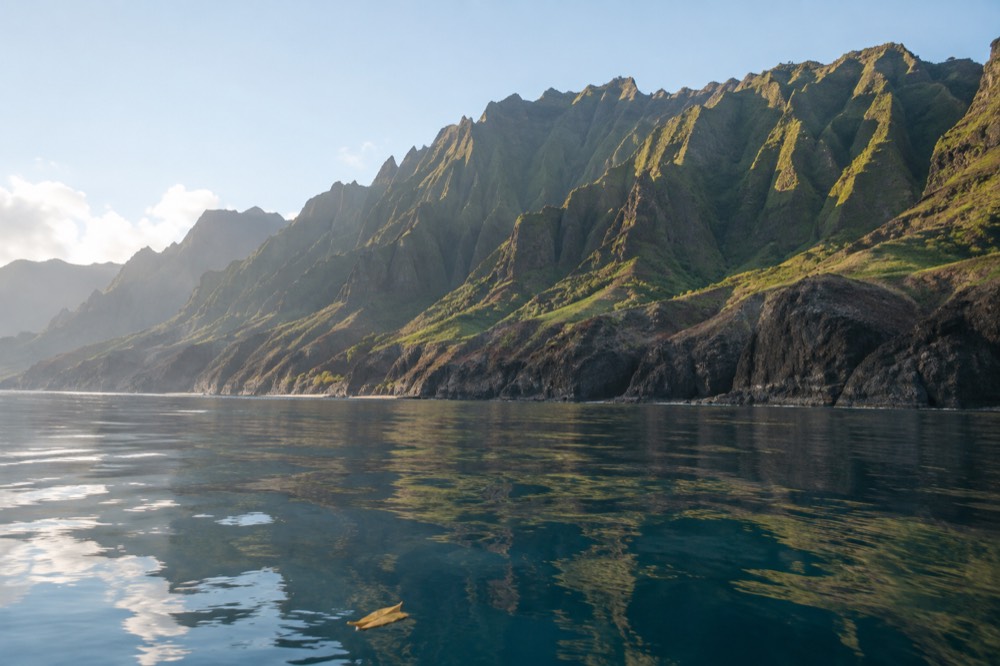
One counterintuitive point: the rough months are also the whale months. Humpbacks arrive in Hawaiian waters from November through April, which is almost exactly the window in which the buoy records its largest seas. A winter visitor who wants whales and calm water at the same time is asking the ocean for two things it does not deliver together, which is a good part of the reason winter whale products run along the sheltered south and west shores rather than the exposed Napali cliffs. Our guide to the Napali Coast boat tour season covers the month-by-month product mix in more depth.
What Actually Works To Prevent It?
What works is medicating before boarding, not after: oral meclizine or dimenhydrinate taken about two hours before departure, or a scopolamine patch applied at least four hours ahead. Beyond drugs, the evidence-backed habits are looking at the horizon, staying amidships and low, avoiding heavy or greasy pre-tour meals, and keeping alcohol out of the morning.
The medication timing is where most people fail. The CDC's travel health guidance lists oral meclizine at 25 to 50 mg with onset around two hours and duration around eight hours, and dimenhydrinate at 50 to 100 mg with the same two-hour onset. The scopolamine patch is the long-game option: the FDA label for the transdermal system says to apply one patch at least four hours before the antiemetic effect is needed, and it then delivers roughly 1 mg over three days. A patch applied in the harbor parking lot does nothing for that morning's crossing; the same patch applied the night before does.
| Method | When to take or apply | How long it lasts | Best for |
|---|---|---|---|
| Meclizine 25 to 50 mg | About 2 hours before boarding | About 8 hours | A single day tour; mild drowsiness |
| Dimenhydrinate 50 to 100 mg | About 2 hours before boarding | About 8 hours | Cheap and widely available; more drowsy |
| Scopolamine patch | At least 4 hours before, ideally the night before | About 3 days | Multi-day trips or very prone stomachs |
| Ginger (chews, tea, capsules) | Morning of the tour | Short | Mild queasiness; evidence is modest |
| Horizon gaze and mid-deck seat | From boarding onward | Continuous | Everyone; free and no side effects |
The behavioral side is free and underrated. Motion sickness comes from a sensory conflict, so giving your eyes a stable reference reduces it: fix your gaze on the horizon or on the cliffs rather than on a phone, a book or the deck at your feet. Stay amidships and low, where the boat's arc of motion is smallest; the bow slams and the stern swings. Eat a light, plain breakfast rather than nothing at all or a plate of greasy loco moco, keep alcohol out of the pre-tour hours, and hydrate. If queasiness starts, moving out into fresh air and facing the wind helps more than retreating to the cabin.
A word about the water itself: operators on this coast do not supply wetsuits and the ocean runs roughly 74 to 80 degrees year-round, so cold-water shock is not the issue it would be elsewhere. The issue is purely motion, which is why the prevention list above is entirely about your inner ear and your habits.
Readers planning the whole day can also stack the odds with timing; our piece on the best time of day for a boat tour looks at how morning and afternoon conditions differ on this coast.
Where Should You Sit?
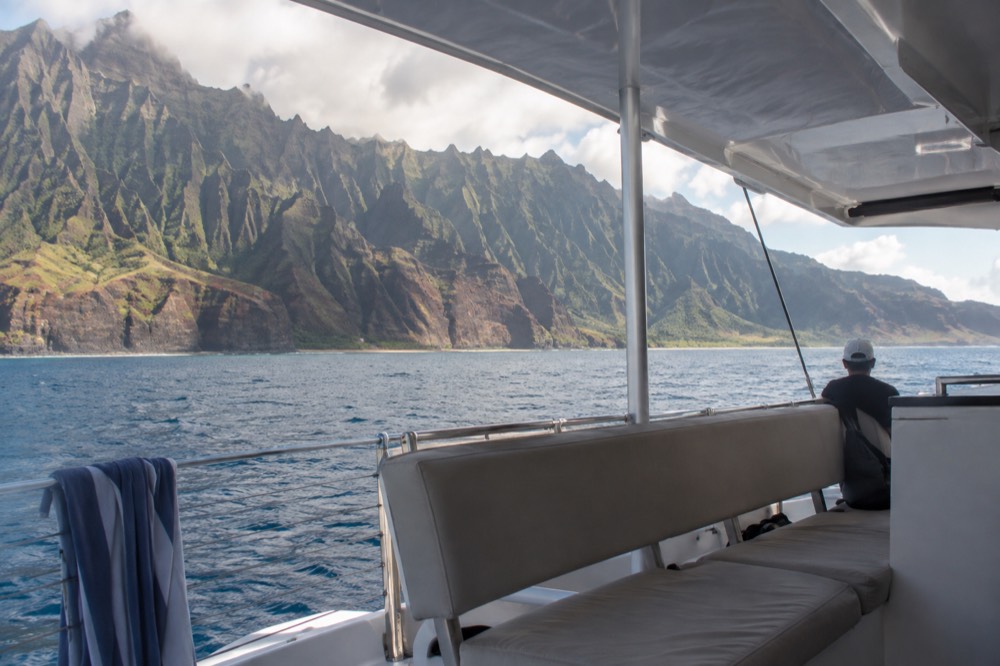
Sit amidships and low, the point around which the boat pitches and rolls the least, and face forward toward the horizon. On a catamaran that means the main cabin or the mid-deck seating rather than the bowsprit or the upper rail; on a raft every seat is close to the water, so the middle tubes beat the front row. Avoid the stern, where engine exhaust and wide swinging both land.
The midship logic applies to every vessel type but matters most on the boats with the most motion. On a catamaran the front trampoline or bowsprit area is the fun seat and the wet seat, and it moves through the largest vertical arc on the boat. The center of the deck, near the cabin, moves least. On a raft the difference between rows is smaller because the whole hull is 24 to 30 feet long, but the bow tube still takes each wave first, and the passengers strapped there get the spray and the drop. The stern on either boat is where spent air and exhaust collect, and stale air makes nausea worse, not better.
Facing direction is the second half of the rule. A passenger who sits facing backward, looking at where the boat has been, feeds the sensory conflict directly: the inner ear registers forward motion while the eyes register a receding view. Sit facing the direction of travel, or better, stand at the rail and watch the horizon. Many people who feel fine on deck start to fade the moment they go below to use the head or sit in an enclosed cabin, so treat enclosed spaces as short visits, not shelter.
One more honest note: on the small 14-guest rafts and 36-guest catamarans, seat choice is partly decided by the crew for weight balance, and you may be assigned a spot. Ask at check-in, say you are prone to seasickness, and ask to be placed amidships; crews on this coast field that request constantly and will usually help where they can.
What Do Operators Do If You Are Sick?
Crews treat seasickness as routine: they hand out crackers and water, move you amidships to fresh air, coach your breathing and gaze, and in genuine distress the captain can alter route, cut a stop or return early. Every tour on this roster carries free cancellation, and operators rebook weather-bumped guests first rather than arguing about refunds.
No crew on this coast is surprised by a seasick passenger. The standard playbook is simple: get the person to fresh air, amidships, facing the horizon; give dry crackers, sips of water and sometimes ginger; and keep them away from enclosed spaces and strong smells. Captains can and do adjust, running a more sheltered line inside the valleys, dropping a snorkel stop, or shortening the day if someone is truly unwell. Holo Holo Charters states that when conditions require a route change, the captain communicates it at check-in and guests can continue, reschedule or take a full refund.
The refund picture matters to a nervous reader. Ocean conditions, wind and swell are the primary cancellation factors, as operators state plainly, and rain alone does not cancel a tour. When the operator cancels, you get rescheduled first and refunded otherwise. When you simply feel unwell mid-tour, there is no refund for the remainder, which is one more reason the prevention steps earlier in this page are worth the small effort.
Booking early in your stay is the operators' own advice, and it is good advice: it leaves room to rebook on another day if the ocean or your stomach does not cooperate. A tour booked for your last morning on Kauai cannot be rescheduled.
Which Tour Should A Weak Stomach Book?
A weak stomach should book a catamaran in the June-to-September window, ideally a mid-size power catamaran with a moderate passenger count, and medicate two hours before boarding. The Express Na Pali Snorkel Tour aboard 'Imiloa fits that brief almost exactly: a 36-guest power catamaran, four and a half hours, from $212 per person.
The 'Imiloa express tour is the roster's natural pick for nervous stomachs, and the reasons are structural rather than promotional. It is a power catamaran, so it has the stable two-hull ride; it caps at 36 guests, so it avoids both the 14-passenger raft motion and the 49-passenger crowd; and at four and a half hours it is long enough to cover the coast and a snorkel stop without the fatigue of a six or eight-hour day. It rates 4.7 from 346 reviews, runs from $212 per person with lunch and breakfast included, and operates April to December, which covers the entire calm season. Free cancellation comes standard.
Two alternatives round out the shortlist depending on what you want from the day. The Na Pali Coast Power Catamaran from Na Pali Experience, 4 hours 30 minutes from $274.93, rating 5 from 811 reviews, is the same gentle hull type with a smaller operation behind it, departing Kikiaola near Waimea. The 6-hour Snorkel and Sail Tour from Holo Holo, from $292.48 with two meals, rating 4.8 from 582 reviews, is the pick for readers who want the sailing experience: under sail the motion is smooth, and the longer day suits a confident summer sea state.
Readers who want the honest bottom line on the whole question can pair this page with our fuller take on whether the Napali Coast boat tour is worth it, and the comparison of Napali Coast catamaran tours lays out the full comfort fleet side by side. If you do feel sick, remember the crew has seen it a thousand times, the ocean usually flattens inside the valleys, and the cliffs are still worth every minute of the crossing. This guide is published by Napali Coast Boat Tours to help you book the right boat the first time.
Common Questions About Getting Seasick On A Napali Boat Tour
Will I Get Seasick On A Napali Boat Tour?
Maybe, but the odds are heavily in your favor if you book well. Choose a catamaran over a raft, travel between June and September when measured swell is at its annual minimum, medicate two hours before boarding, and sit amidships facing the horizon. Most guests who prepare this way complete the tour comfortably.
Which Boat Type Is Gentlest On The Napali Coast?
Power and sailing catamarans are the gentlest, with wide stable hulls that damp the swell. Rigid-hull inflatable rafts are the roughest, fast and low to the water, though they are the boats that can enter the sea caves. A mid-size power catamaran is the usual sweet spot for a nervous stomach.
Which Months Have The Calmest Water For A Napali Tour?
June through September are the calmest, when the Hanalei wave buoy records swell at or above 2.5 meters in under two percent of observations. May and October are good shoulder months. November through March brings the large north Pacific swell and the highest seasickness risk.
What Medication Works Best For Boat Seasickness?
Oral meclizine at 25 to 50 mg or dimenhydrinate at 50 to 100 mg, taken about two hours before boarding, last around eight hours. A scopolamine patch delivers about three days of protection but must be applied at least four hours before the effect is needed, ideally the night before.
Where Is The Best Place To Sit On A Boat To Avoid Seasickness?
Amidships and low, facing forward toward the horizon. Avoid the bow, which moves through the largest arc, and the stern, where exhaust collects. On a raft, the middle tubes beat the front row, and fresh air at the rail beats any enclosed cabin.
What Happens If I Get Sick During The Tour?
Crews treat it as routine: they move you amidships into fresh air, offer crackers and water, and coach your gaze and breathing. Captains can adjust the route or cut a stop if needed. If the operator cancels for conditions, you are rescheduled first or refunded in full.