Are There Any Sea Caves In Kauai?
Yes, Kauai has sea caves, and the Napali Coast holds the famous ones. Here is where they are, which boats can actually enter, and what decides whether you get inside on the day.
Are There Any Sea Caves In Kauai?
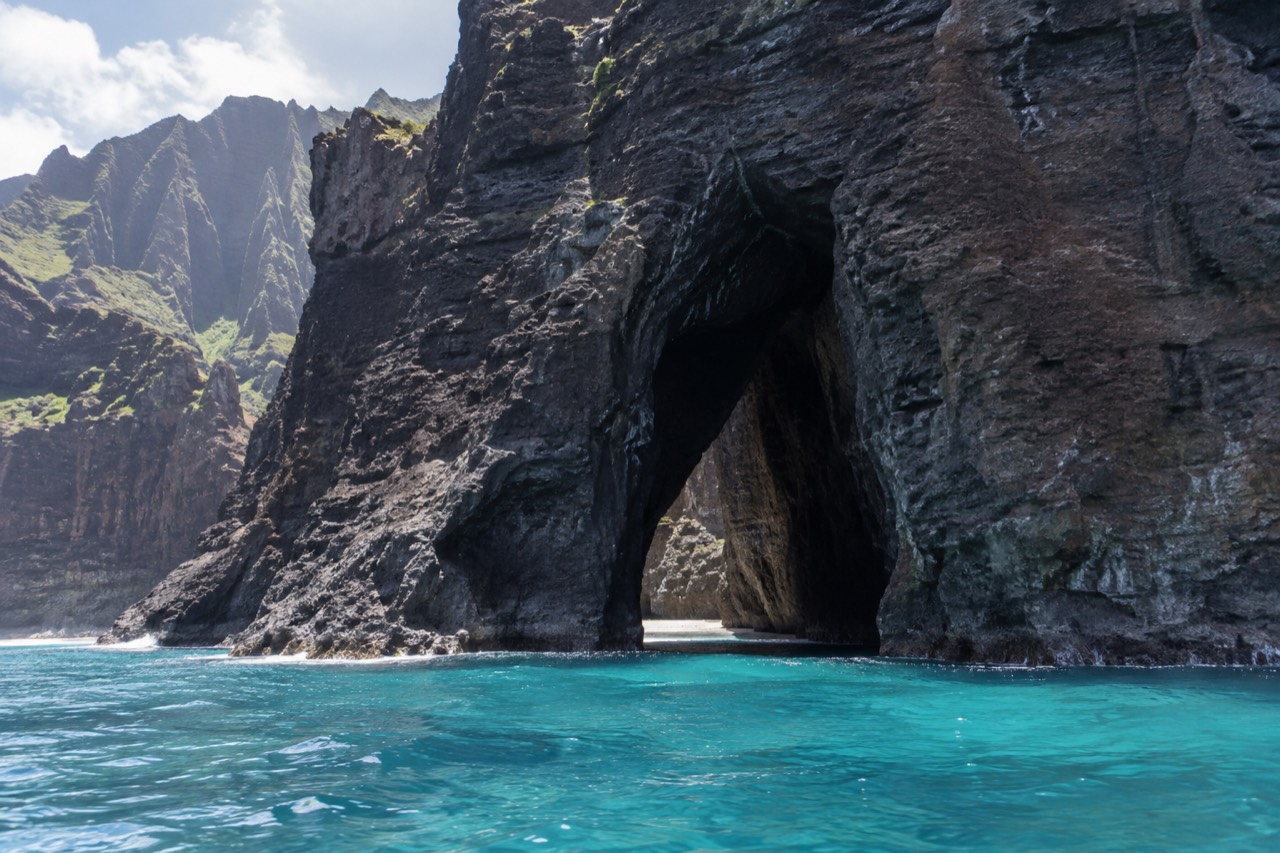
Kauai has sea caves, and the ones worth the flight are concentrated on the Napali Coast, the 16-mile wilderness shoreline on the island's northwest side. They are lava tubes and wave-carved chambers set into cliffs that in places rise well over a thousand feet, and there is no road, no trail and no beach walk that reaches them. The only practical way to see the inside of one is from a small boat, and even then the ocean gets the final say.
That last part is the detail most travel content skips. Cave entry along this coast is never promised, by any operator, on any tour, in any month. What is promised is that a rigid-hull raft will try, if the captain judges the swell safe. This article lays out where the caves are, which boats fit inside, what shuts them, and which specific tours give you the best odds.
Are There Sea Caves On Kauai?
Yes. Kauai has sea caves along the Napali Coast, a 16-mile stretch of wilderness shoreline on the island's northwest side. The caves formed as ancient lava tubes that wave erosion widened into open chambers, some with collapsed ceilings that work as skylights and freshwater cascades pouring toward the sea. They are reachable only by boat, and entry is always at the captain's discretion.
The Napali Coast State Wilderness Park covers 6,175 acres of deep, narrow valleys and sheer cliffs, and the sea has been carving into the base of those cliffs for as long as the waves have been running. Operators describe the caves as lava tubes from ancient eruptions that the ocean widened over millennia, which is why they sit right at the waterline rather than high on the cliff face. Some chambers have open ceilings where the roof gave way, letting daylight, and sometimes a thin waterfall, drop straight into the sea.
What surprises many first-time visitors is how few of these caves exist anywhere else on Kauai. The island's other coasts are mostly lower, sandier and more open, without the vertical rock needed for a cave system to survive the surf. The Napali cliffs supply exactly that geometry: hard basalt, deep water at the base, and a long fetch for swell to work against. The caves are a Napali phenomenon, which is a large part of why the boat tours there are so heavily booked.
It also means the caves are a boat-only feature, and the boat has to be small. A cave entrance that a 24-foot rigid-hull raft slips through comfortably will not admit a 49-guest sailing catamaran, and no operator on this coast pretends otherwise. The full breakdown of which vessels enter and which merely cruise past is further down this page, in the section on boats.
If you already know you want the cave experience and you are comparing options, these three tours cover the range: a dedicated cave-and-snorkel raft, a longer raft with breakfast, and a power catamaran that gets close without entering.
Where Are The Napali Sea Caves?
The sea caves sit along the Napali Coast between Polihale and Hanalei on Kauai's northwest shore, concentrated in the stretch of cliffs boats reach roughly 30 to 60 minutes after leaving the west-side harbors. Tours depart from Port Allen in Eleele or Kikiaola near Waimea and Kekaha, both on the island's southwest side. There is no north-shore harbor at all.
Every cave tour on this island's roster leaves from the west side, and that geography matters. Port Allen Small Boat Harbor in Eleele is the main base, with 18 of the tours on this site departing there, and Kikiaola Small Boat Harbor near Waimea and Kekaha accounts for the other 8. Hanalei on the north shore has no harbor facility at all, so a reader searching for a north-shore cave tour is really searching for a long drive west. The practical guide to those two harbors, drive times and check-in logistics is covered in getting to Port Allen and Kikiaola.
Once underway, the boats run up the coast past the first valleys and work the cliff line where the caves cluster. Operators do not publish a fixed cave-by-cave itinerary, partly because conditions shuffle the order and partly because the coast is a moving target: a cave that is safe at 9 a.m. can be unsafe by noon if the swell builds. Captains assess each entrance on approach, every single time.
The caves themselves carry English trade names in tour copy, such as Open Ceiling Cave and Pirates Cave, and this site deliberately sticks to those names. Various sources attach Hawaiian names to individual caves, but those sources conflict with each other and with the operators' own pages, so repeating them would be guessing. The cliffs, the arches and the caves are the facts; the naming is folklore with competing versions.
One landmark worth knowing is Honopu Arch, a gazetted natural feature on the coast, a massive rock arch that appears in plenty of Napali photography. It sits in the stretch of coast boats pass on nearly every tour, and it is a good visual marker that the cave zone is beginning.
What Is The Open Ceiling Cave?
The Open Ceiling Cave is the most photographed sea cave on the Napali Coast, a lava tube chamber whose roof collapsed, leaving a circular skylight open to the sky. Boats that enter it drift inside a ring of rock with daylight pouring through the ceiling, and after rain a thin freshwater cascade may fall through the opening. Entry depends entirely on the swell on the day.
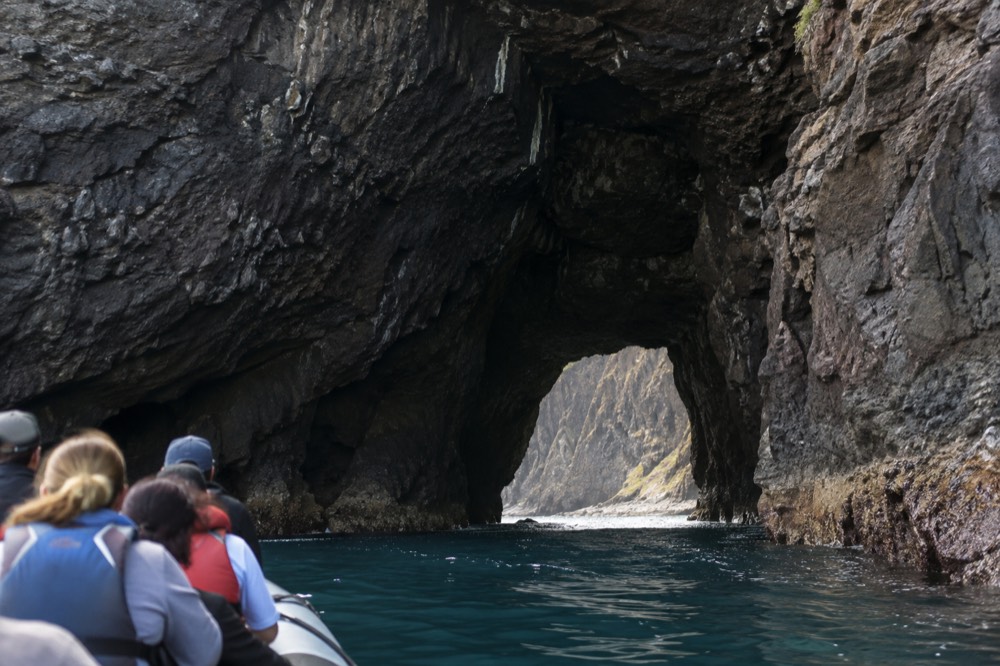
This is the cave that sells the coast. The collapsed-ceiling format is geologically simple: the tube held for thousands of years, then a section of roof gave way, and the ocean kept the floor. What is left is a natural amphitheatre with water inside it, and on the calm mornings of summer a small raft can ease in and sit in the light. Operators note that some caves on this coast feature freshwater cascades, and when conditions allow, raft crews will sometimes run the boat through or over a cave-mouth waterfall, which soaks everyone aboard and is usually received as a bonus rather than a hazard.
The honest caveat is that the Open Ceiling Cave is also the most condition-dependent stop on the coast. Its opening faces the swell that funnels along the cliff base, and when the ground swell is running, the same geometry that makes it spectacular makes it off-limits. Captains make that call on the spot, from the water, having watched the entrance work for a few minutes. A tour that entered it yesterday may not enter it today, and no crew will commit in advance.
Photography inside is genuinely good when you get in: the skylight gives even, downward light, the water is a deep blue-green, and the scale of the rock reads on camera. If the cave is the main reason you are booking, aim for a summer departure, book a raft rather than a catamaran, and read the sections below on swell and guarantees before you set expectations. For swimmers, the separate question of whether you can swim in these caves has its own answer, covered in can you swim in sea caves.
If a cave interior is the goal rather than a maybe, the raft products are the ones built for it.
Can You Reach Any Cave From Land?
No. No Napali sea cave can be reached from land. The coast has no road, and the Kalalau Trail, the only foot route along the cliffs, runs 11 miles one-way high above the shoreline and never descends to a cave entrance. The caves are visible in places from the ocean-side trail, but entering one requires a boat, and landing is restricted to three permitted raft operators.
The land route is the Kalalau Trail through the Napali Coast State Wilderness Park, an 11-mile one-way hike across five valleys to Kalalau Beach, and even that does not touch the caves. Access to the trailhead runs through Hāʻena State Park, where non-residents need a day-use entry reservation at $5 per person plus a parking reservation at $10 per vehicle, released 30 days in advance, and demand is heavy. Beyond Hanakapi'ai Beach, two miles in, hikers must hold an overnight camping permit for the wilderness park, at $35 per person per night for non-residents, bookable up to 90 days ahead. The details, deadlines and permit mechanics are laid out in the Kalalau Trail guide.
Even from the trail's high points, the caves are distant geometry. The trail sits hundreds of feet above the water for most of its length, and the cave entrances are at sea level, tucked under cliffs. Drones, the obvious workaround for a closer look, are prohibited: Hawaii Administrative Rules Chapter 13-146 bars launching or landing unmanned aircraft in all state parks, state beaches and wilderness areas without written DLNR approval, per the state park rules. So the aerial cave footage circulating online was almost all shot from permitted aircraft or from boats.
Kayaking is sometimes suggested as a do-it-yourself cave route, and the state rules close that door too. Kayak landings are prohibited at all beaches in the park except Kalalau Valley with a camping permit and Miloli'i in summer, and paddling the coast is only permitted between 15 May and 7 September. More importantly, a kayak gives no cave-entry safety advantage: the same swell that stops a 24-foot raft stops a 14-foot plastic boat far more completely.
The short version: the caves are a boat feature. The land gives you cliffs, valleys and a serious hike, and the sea gives you the caves.
Which Boats Go Inside?
Only small rigid-hull inflatable rafts enter the Napali sea caves routinely. The typical cave boat is a 24 to 30-foot raft with a shallow draft, low profile and a skilled captain. Sailing catamarans are too tall, wide and deep to pass the entrances, and they cruise past instead. One small power catamaran on the coast states its vessel is built to enter, but the raft is the reliable choice.
The physics is unforgiving. A cave entrance is a low, narrow gap in basalt, and a boat needs three things to fit: minimal height, minimal beam and minimal draft. A rigid-hull inflatable scores on all three, which is why operators describe their rafts as the cave vessels and state plainly that larger boats cannot safely enter due to height, width and draft. The operators' own sea cave pages make the point directly, and no sailing catamaran on this coast disputes it.
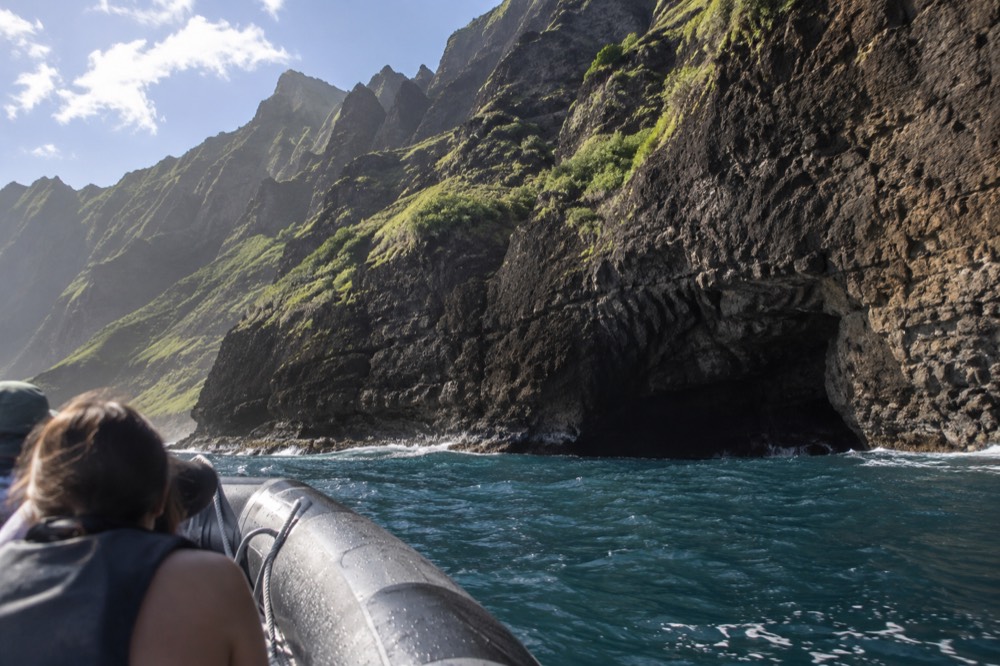
The nuance worth knowing is that "catamarans can't enter" is not quite universal. One north-shore power catamaran operator states its vessel is specifically designed for entering sea caves, a claim about its own boat, while agreeing that no sailing catamaran can. This site's honest framing: rigid-hull rafts are the proven cave format, large sailing catamarans do not enter, and at least one small powered catamaran says it does. If the cave interior is your priority, book the raft.
| Boat format | Enters caves? | Typical guest count | What you get instead |
|---|---|---|---|
| Rigid-hull inflatable raft | Yes, conditions permitting | 14 to 30 | Cave interiors, close cliff runs, snorkel stop |
| Sailing catamaran | No | Up to 49 | Smooth ride, sails, coastline from outside the caves |
| Power catamaran | Generally no, one operator claims yes | 20 to 49 | Fast coastline transit, snorkel, stable deck |
On this site's roster, the raft options include the Na Pali Super Raft Snorkel Adventure from Captain J's, a 4 hour 30 minute Port Allen trip rated 4.8 from 1723 reviews, from $235 per person with snacks included, and the Kauai Sea Tours raft snorkel adventure, 5 hours 30 minutes, rated 4.8 from 1656 reviews, from $217 with breakfast and a maximum of 14 guests. Both carry free cancellation, which matters on a coast where weather moves trips.
The Kikiaola-based Zodiac products from Na Pali Riders are the other cave-capable family, including a 3 hour sea caves expedition rated 4.9 from 155 reviews and a 4 hour snorkeling expedition rated 4.9 from 956 reviews, both from $235 and $255 respectively. Shorter and slightly cheaper, they trade some water time for a tighter cave focus.
What Closes The Caves?
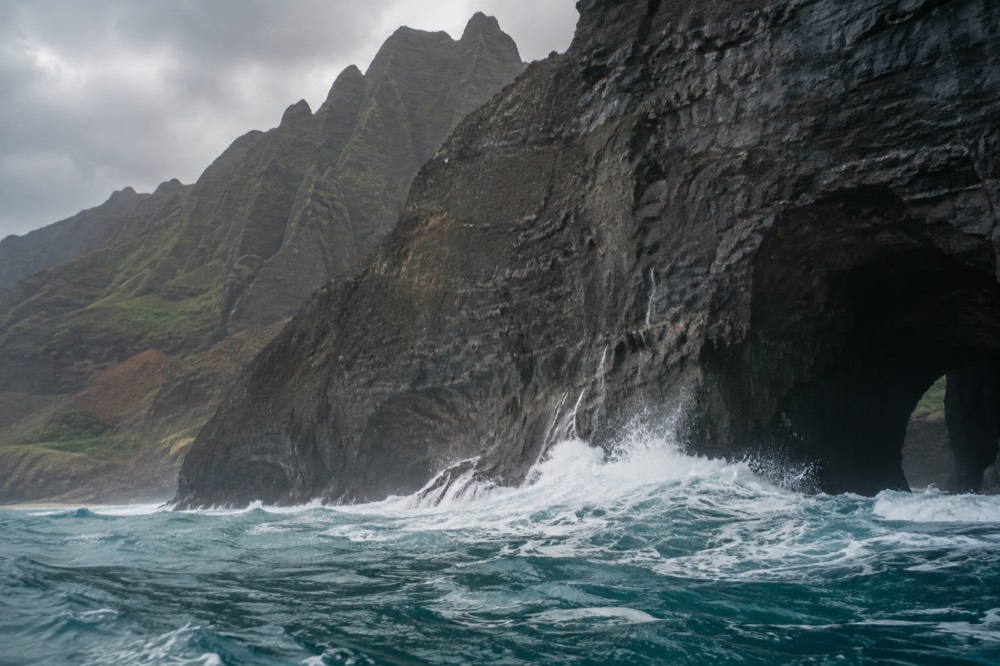
Ground swell is what closes the caves, and its size, not the time of day, is what captains judge. Summer months, roughly May through September, offer the highest likelihood of entry because northwest swells settle. In winter, conditions are rougher and full cave access is less likely. Wind, surf and the captain's read of each entrance on the day decide everything.
Operators are unusually consistent on this point. The swell governs, the swell is not tied to morning versus afternoon, and summer is the better bet. That aligns with the measured sea state on this coast's exposed side: two recent years of buoy data show June through September essentially free of large offshore seas, while December through January records significant wave heights at or above 2.5 metres about half the time. The caves feel that regime first, because a chamber that is charming in a 1 metre swell becomes a hazard in a 3 metre one.
| Condition | Effect on cave entry | Typical season |
|---|---|---|
| Small ground swell, light wind | Entry usually possible | May to September |
| Moderate swell, building trades | Captain decides entrance by entrance | April, October |
| Large ground swell | Caves closed, coastline tour continues | November to March |
| Rain without swell or wind | Little effect, tours run | Any month |
Rain, notably, is not a closure factor on its own. Operators state that light rain does not stop a tour and that it commonly rains on land while the water is clear, because the coast's weather is localized. What stops a cave run is energy in the water: swell height, wind against current, and surf pushing into an entrance.
There is also a regulatory ceiling on how many boats are even out there. Following a December 2024 court order, the state is issuing no new commercial use permits, and existing permittees may not increase passenger capacity, per the DLNR clarification on ocean commercial use permitting. The fleet is fixed, which is one more reason the cave-capable rafts book out in summer.
Is Cave Entry Ever Guaranteed?
No. No operator on the Napali Coast guarantees cave entry, and several disclaim it in writing on their own pages. Snorkeling, cave access and beach landings are all conditions permitting and are never promised. The captain assesses the water on the day of the tour, not before, and a tour that cannot enter the caves still delivers the coastline, the cliffs and usually a snorkel stop.
This is worth stating hard, because the internet softens it. One operator's FAQ says snorkeling, cave access and beach landings are all weather and ocean condition dependent and not guaranteed. Another says the captain makes the determination on the day of the tour if it is safe. A third says captains decide once they see the water that day, not before. Three independent companies, same policy, in writing. Any listing or article that promises cave entry is selling something the operators themselves will not promise.
What you are actually buying, then, is a probability, and you can move that probability in your favour. Summer departure, raft format, morning trip, flexible schedule with a backup day: those stack the odds. Booking the first day of a week-long stay beats booking the last, because if the swell closes the caves you have room to rebook, and every tour on this roster carries free cancellation, so a weather-driven change costs you time rather than money.
The failure mode is mild and well-handled. If the caves are off, the tour becomes a coastline cruise: cliffs, waterfalls, sea arches, dolphin encounters when the dolphins cooperate, and a snorkel stop if the water allows. Operators communicate route changes at check-in and offer continue, reschedule or refund options. Nobody gets abandoned at the dock; they get a different version of a very good day.
Set your expectations the way the captains set theirs: the caves are the goal, the coastline is the guarantee, and the ocean decides the split. That framing is honest, and it is also the difference between a disappointed review and a great one.
Which Tour Gives You The Best Chance?
A rigid-hull raft from the west side in summer gives the best chance of entering the caves, and the Na Pali Super Raft Snorkel Adventure is the strongest single pick: 4 hours 30 minutes from Port Allen, rated 4.8 from 1723 reviews, from $235 per person with snacks and free cancellation. It pairs cave attempts with a snorkel stop and runs the format captains actually use to enter.
The logic is cumulative. Raft format for the entrance, Port Allen or Kikiaola for the shortest run to the cave zone, a duration long enough to wait out a building swell or work a second entrance, and a departure month inside the calm season. The Super Raft product ticks each box, and its review pool, 1723 reviews at 4.8, is one of the deepest on the coast, which says something about how consistently it delivers.
| Tour | Format | Duration | From | Rating |
|---|---|---|---|---|
| Super Raft Snorkel Adventure | Rigid-hull raft | 4 hours 30 minutes | $235 | 4.8 from 1723 reviews |
| Na Pali Raft Snorkel Adventure | Rigid-hull raft, max 14 | 5 hours 30 minutes | $217 | 4.8 from 1656 reviews |
| Zodiac Raft Expedition and Snorkeling | Rigid-hull raft | 4 hours | $255 | 4.9 from 956 reviews |
| Zodiac Sea Caves Expedition | Rigid-hull raft | 3 hours | $235 | 4.9 from 155 reviews |
If your dates are flexible, weigh the alternatives honestly. The Kauai Sea Tours raft at 5 hours 30 minutes spends the longest on the coast and caps at 14 guests, the tightest group on this list, which some travellers prefer for photography. The Kikiaola Zodiac products are shorter and sharper, built almost entirely around the caves, and suit a morning with a full afternoon planned elsewhere. The sailing catamarans, meanwhile, are the right choice when caves are a nice-to-have and a smooth, spacious, meal-included cruise is the actual goal, a comparison this site covers in depth in Napali Coast catamaran tours.
Whatever you book, book it early in your stay, watch the swell forecast in the days before, and go in knowing the deal every captain on this coast works under. The caves are real, they are spectacular, and on the right morning a small raft will carry you inside one. Planning the trip around that possibility, rather than treating it as a certainty, is what separates the visitors who get the caves from the ones who get the coastline. For the full picture on this coast's cave access, formats and seasons, start with Napali Coast Boat Tours and the dedicated Napali sea caves guide.
Common Questions About Kauai Sea Caves
Are There Any Sea Caves In Kauai?
Yes. Kauai's sea caves sit along the Napali Coast on the island's northwest side, formed as lava tubes widened by wave erosion. They are reachable only by boat, and only small rigid-hull rafts enter them, conditions permitting.
Can catamarans enter the Napali sea caves?
Sailing catamarans cannot enter, they are too tall, wide and deep, and they cruise past the entrances instead. Rigid-hull rafts are the standard cave boat. One small power catamaran operator states its vessel is built to enter, but the raft remains the reliable format.
What is the best month for cave entry on the Napali Coast?
Summer, roughly May through September, offers the highest likelihood of entry because the northwest swells settle. Operators state plainly that summer usually allows cave entry and winter conditions tend to be rougher, making full access less likely.
Is cave entry guaranteed on any tour?
No. No operator guarantees cave entry, and several disclaim it in writing. Captains assess the swell at each entrance on the day of the tour, and access is always conditions permitting.
Can you hike or kayak to the Napali sea caves?
No. The Kalalau Trail runs 11 miles one-way high above the shoreline and never reaches a cave entrance, and kayak landings are prohibited at all park beaches except Kalalau with a camping permit and Miloli'i in summer. The caves are boat-only.
Do the cave tours also include snorkeling?
Most raft tours pair cave attempts with a snorkel stop, typically 30 to 60 minutes in the water at a spot the captain chooses for the day's conditions. The snorkel stop is also conditions permitting, never guaranteed.